
The Mining Camp
The team travelled until about midday, when the road ended at the mining camp. Stopping in cover, Niven snuck up and discovered that the camp had been ransacked.
Huddled beside a twenty-foot-high rocky outcrop were a dozen or more tent shells, many head-high stacks of crates, various long tubes and bits, a tiny shack marked Explosives, and an undamaged small building with mechanical gear secured on top of it. There was a truck at the end of the row of tents, riddled with bullets. Niven called to the others and they cautiously approached, leery of another ambush by von Klugge and his men.
When they get closer, they saw human corpses amidst the sand and rubble. Several bodies were more or less whole, but had been hacked as with swords. The entire camp had been meticulously searched, but the team looked for themselves and found a canvas satchel containing survey maps and assorted papers that had been hastily buried underneath a makeshift bed in the sole intact tent. A formation called the Piercing Ridge was circled in pencil. It was approximately another day’s ride further north.
They inspected the mining shaft, suspicious that their opposition might have gone down the elevator until they smelled dead bodies coming from below. Raising the elevator, they discovered the bodies of several dead Englishmen inside. They availed themselves of supplies and departed quickly in the direction of the Piercing Ridge.
In the late afternoon, a sudden sandstorm erupted. Thanks to Niven’s quick reaction, he discovered a sheltering defile just in time. The team survived the storm intact, but had lost half a day’s travel. As it was getting dark, they made camp. They would arrive at the Piercing Ridge mid-morning tomorrow.
The night was uneventful, but shortly before dawn, while Craven was on watch, he heard the sound of horses nearby. He skirted around one of the sheltering dunes, but did not see anything until a line of travelers on camels passed by from the blind side. The travelers did not notice him, and Craven silently watched them pass by.
To the Piercing Ridge
Following the road, it passed through a deep ravine. Once the entrance was out of view, a rain of boulders descended from the sides. The team successfully avoided being crushed, only to find themselves set upon by Von Klugge and his Turks from above. Each was hit before fleeing down the ravine. Craven managed to avoid the boulders and make haste through the trap. The enemy did not pursue them.
The ravine continued for several miles before opening up into a valley. As they approached the area indicated on the map, they could see why it was called the Piercing Ridge: large sandstone blocks of rock jutted out from the dunes, bordered by a rocky outcropping. Due to the years of howling winds and erosion, the blocks had been filed down into mammoth pointed stakes. The ridge itself was just under half a mile in length and provided natural protection from the winds, as giant gusts blew sand over the ridge and into the sky like the waves of the ocean breaking against the reefs.
The sun was starting to set, so Velati made camp. Craven and Niven elected to explore. Following a rutted path that Niven spotted in the fading light, they wound up one of the formations and uncovered the remnants of demolished scaffolding suggesting the presence of a recently excavated section refilled by the blowing sands. Digging out this area revealed a pair of double doors. Examining the elaborate friezes embedded in the doors revealed an intricate locking mechanism. Niven’s expert skill with locks enabled him to quickly decipher the combination and succeed in opening the doors. In spite of the age and weathering, the doors opened cleanly and quietly.
Inside the Tomb
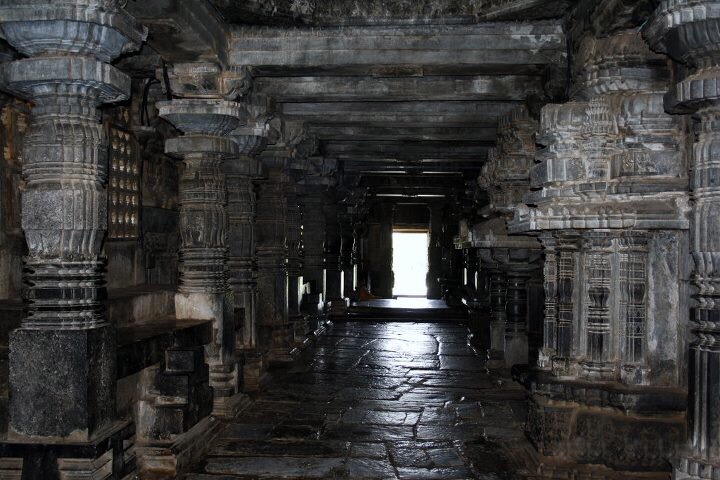
Beyond the double doors, the Interior was pitch black. By the light of the entry, they could make out two rows of columns on either side of a central aisle. They turned on their electric torches to explore the room.
With Velati outside covering the doorway from his vantage near the campsite, Craven and Niven advanced into the darkness. Niven scouted ahead down the aisle, while Craven examined one of the columns. It was covered in hieroglyphics, but they were not of Egyptian or any other recognizable design. Nevertheless, they seemed vaguely familiar to the pilot.
Niven discovered that there were two rows of columns on each side, for a total of sixteen columns in all. All of the columns bore the strange hieroglyphics. Beyond the columns was a four foot high wall, with a stairway up to rows of smaller columns.
Craven examined more of the columns. He was somehow able to decipher some of the text identifying phrases indicating the presence of another level, and a secret key needed to unlock access. On other columns, he discerned that a certain symbol was significant, but did not know why.
While Craven was examining the columns, Niven continued to explore. He was approaching the stairs when he felt a breeze from behind. He realized that someone had entered the tomb behind them. He went to the doors closed them, and extinguished his electric torch, casting the chamber into darkness.
Listening carefully, they sought the sounds of movement, but their others were experts. Niven extinguished his electric torch. He then threw a stick grenade in the direction that he had heard movement with the pin intact to startle his opponents. He heard the sound of someone jumping out of the way, but not the sound of the grenade hitting anything.
Niven and Craven played cat and mouse with the unknown interlopers. Eventually, Niven made out footprints in the dust on the floor. Following them with his torch lit again, he found von Klugge and his Turkish lieutenant threatening Craven. The German and the pilot had their pistols drawn. The Turk held Craven’s grenade in one hand and his rifle in the other.
Niven sot the Turk and Craven shot the German. The lieutenant threw the grenade, but it bounced off a column, and then the wall before landing and exploding just beyond the elevated section. A cloud of dust enveloped the chamber, and the enemy agents disappeared.
Craven noticed the the columns on the raised area had rotating sections that bore a hole. Examining one of these, he realized that the glyphs from the lower columns completed a word when the rotating section was turned so that it appeared in the hole. He had figured out the key!
Having heard the shots inside, Velati entered the tomb, where he discovered his colleagues unharmed. As the dust cleared, Niven saw the enemy flee up the stairs and deeper into the tomb. He advanced to the entry to the next room, but did not see them. Velati advanced and covered Niven while he explored the further chambers. The room beyond contained an enormous Persian Sphinx statue. Detecting no sign of the opposition, Niven examined the statue for any seams that might indicate a secret panel, but found none.
In the mean time, Craven examined the remaining columns in the initial chamber and identified what he believed to be six unique and significant runes. Examining the twelve smaller columns on the elevated section, he identified the runes needed to complete specific words when exposed by the hole in the revolving section of each column. He did not understand the words, but somehow he knew that the symbols completed them. Each symbol was used in two different columns. When he set the last one, the stairway leading up to the elevated section dropped away from the upper end, yielding a stairway down from the entry level into darkness.
Alerted by the sound of the stairs falling, Craven left tripwire grenades for von Klugge and his friend. Then he and Velati joined Craven at the entry to the lower level.
The Team
- Sir Lyton Niven, Gentleman Thief and Spy
- Capt. Philip Harrison Craven, WWI Flying Ace
- Arashk Velati, Persian guide