
A Damsel in Distress
Sir Jonathan Dennis Braun of Eatin-over-Heywoods received a telegram from Lady Amelia Cotterill, asking for assistance. The telegram explained that she would be in London in two days’ time and wished to meet at the exclusive Gore Hotel, Kensington.
Sir Jonathan, not knowing the nature of the problem, invited two colleagues from the lodge, Gravner Stone and Inspector Alabaster Warren, to accompany him. Prior to the meeting, the investigators did some research.
- Warren learned that Lord Arthur Cotterill lived on Dartmoor . He was founder of the Cotterill Armaments Company, and that half a dozen of his patents were used by the British armed forces.
- Sir Jonathan obtained from some acquaintances in the government that Cotterill’s last three patent applications had been turned down, leaving the company virtually bankrupt due to excessive research and development costs.
- Investigating the patents, Stone found that Cotterill’s successful patents included a type of smokeless powder, a breech-loading artillery piece, an explosive shell for naval guns, and the like. The three rejected ones were for a gun so large it required a railway carriage for transportation, an armored, tracked vehicle, and a new type of machine gun capable of tremendous rates of fire.
Meeting at Gore Hotel
Lady Amelia greeted Sir Jonathan in a private parlor just after noon. She was at first distressed by the addition of his colleagues, as she had been informed by mutual acquaintances that he was skilled at dealing with sensitive matters discretely.
Sir Jonathan introduced his companions. He said that Stone, in spite of his reputation, was a handy man to have around. And as it was always advisable to have some support in official channels, Inspector Warren would provide contacts and credibility to their activities.
Her suspicious somewhat assuaged, though she still took exception to Warren, Lady Amelia told her story to Sir Jonathan and Stone. She told them that her father had been murdered at Hethercombe, their family home near Moreton-Hampstead, four days earlier. She herself had been away in India, but returned with her fiancée, an Army captain, the previous day and learned of the terrible news. Her father had been working hard on a new invention and she had returned to ensure that he was looking after himself as he had not been well.
Sir Jonathan, acting for Warren, who Lady Amelia continued to ignore, inquired as to the particulars of the crime. Lady Amelia said that Jacobs, the butler had discovered him dead in his study when he brought the evening tea. Jacobs said that Lord Cotterill had been stabbed by an intruder, and that the safe door was open.
She telegrammed Sir Jonathan as soon as she had learned of the murder and ordered that nothing in the study be touched. Her father’s body was taken to the local doctor for a discrete post-mortem. She said that they were fortunate to live in a small community and that she had managed to keep Lord Cotterill’s death quiet. However, news would undoubtedly leak out, and as a peer of the realm murdered in his home would attract reporters from Fleet Street. She wanted to have the case solved before then to avoid any unnecessary speculation.
Sir Jonathan asked why the authorities had not been consulted. Lady Ameila replied that Sergeant Barnes’ heart was in the right place, but she feared that he lacked the experience to bring her father’s killer to justice.
Stone asked if Lady Amelia knew what Lord Cotterill had been working on. She replied that according to her father’s last telegram, received two weeks ago in Alexandria, he had just finished a new invention and was waiting to hear back from the War Office on the prospect of a contract. As always in these matters, father had been tight-lipped and she did not profess to understand his work.
Sir Jonathan agreed to take the case. Lady Amelia said that should would telegram Jacobs and have him meet the party at the station in Moreton-Hampstead with the carriage. She needed to stay in London and begin sorting out her father’s affairs, but that she would return to Devon as soon as possible.
After the Meeting
After bidding their leave of Lady Amelia, the investigators returned to their homes and packed their bags for a trip to Dartmoor on the 6:00 train. Warren also made inquiries among his contacts in the Patent Office to learn that Lord Cotterill’s latest invention had been a calculating machine that could determine the range to an enemy force and provide firing coordinates. It had been rejected as being too unreliable for the cost of production.
In Moreton-Hampstead
They enjoyed a private compartment for the long, boring trip. The landscape outside was bleak, with mist and rain obscuring the features.
After debarking the train, they looked around the deserted platform. A moment later, a well dressed middle aged man in a tuxedo appeared and introduced himself as Jacobs, the Cotterill’s butler. He collected their bags and loaded them on top of the carriage. It would be about a two hour drive to Hethercombe Manor.
On the Road
About an hour into their journey, the carriage stopped. Looking out, Warren saw Jacobs speaking with a constable. When Sergeant Barnes’ approached the carriage, Warren bullied him into explaining that he was looking for an escaped lunatic from the Brackaton Asylum, who he believed had killed Lord Cotterill. He provided a newspaper with an article about the escape.
Warren interrogated Barnes as to whether he had contacted his superiors for additional resources. The sergeant responded that all four of the constables in the area were out on the moors.
Warren noted that the inmate, a Willy McTavish, was also known as the Strathclyde Strangler, and had committed his crimes with his bare hands, while Lord Cotterill had been stabbed.
Barnes responded that the lunatic must have changed his methods. He resented outsiders investigating a murder in his jurisdiction, but as a loyal friend of the Cotterill family, he agreed to respect Lady Amelia’s wishes with regard to the investigation into her father’s death.
With that, Sergeant Barnes let them continue on their way. They arrived at Hethercombe shortly after midnight. Jacobs prepared a light meal before they went to bed.
The Investigation Begins
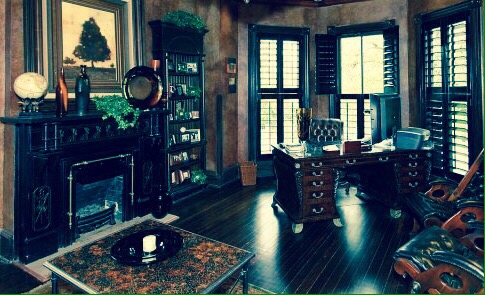
After breakfast, Jacobs showed the investigators to the scene of the crime. As he showed them into the study, he declared that the room was exactly as it was found when Lord Cotterill’s corpse was discovered, save for his lordship’s body having been removed.
Stone noticed that the ashtray on the desk contained the stub of a cigar and a single match. Jacobs told him that Lord Cotterill’s business partner, Mr. Edington Burtle smoked them.
He added that Lord Cotterill and Mr. Burtle had had a frightful row on the day of his death. Their voices could be heard throughout the entire house. Mr. Burtle stormed off without waiting to be shown out. Unfortunately, Jacobs could hear voices, but not words. Jacobs informed them that Mr. Burtle was elsewhere in England on business, but that Lady Amelia left messages for him to come to Moreton-Hampstead as soon as he received them.
Jacobs said that lordship was found in front of his desk, lying in a pool of blood. It appeared that he had been stabbed in the chest and stomach. Doctor Locock, the local physician, was called, but did not discuss the injuries with Jacobs.
Stone examined the desk itself. The top drawer of the desk was locked. They searched the room for the key, but ultimately used the spare that Jacobs had. Stone examined the lock in the drawer and saw no sign of lockpicks having been used. Inside the locked drawer were various papers and a large key, which Jacobs identified as the safe key. The other drawers contained writing paper, envelopes, ink pots, and other mundane items.
The safe was wide open. Stone examined the locking mechanism of the safe. It opened with a key rather than a combination, but there was no key in the lock. It was a complex, top of the line one, meaning whoever picked it was a professional.
Jacobs said that Lord Cotterill kept money and blueprints in the safe. He knew that most of them were available at the Patent Office in London, but his lordship also had designs he had not yet revealed to the War Office or filed for patents, but he did not know what they pertained to.
Inside the safe were various letters, rather mundane design plans, and his will, which listed Lady Amelia as sole heir to the estate. There was no sign of any money or of the latest patents.
While the others were distracted with the safe, Sir Jonathan cast a spell that illuminated barefoot prints to him, which he was convinced were those of a werewolf.
The heavy velvet drapes were closed when they entered the room, but checking behind them, Warren discovered two large windows, one of which had been smashed and boarded up. Jacobs said that the window had been smashed during the murder, probably by the intruder, and although he declared earlier the room had been left untouched, he admitted to boarding up the window to keep out the rain.
Examining the floor, Warren noted that the majority of glass was inside in the room, it was outside, indicating that the window was broken outward. He checked the intact window and discovered scratch marks on the sill, and slight indentations in the carpet by that window, indicating someone stood in the carpet for a long time.
But he estimated that the intruder must have been over 7’ tall and weighed in excess of 300 pounds. It was impossible to deduce with any accuracy, but he thought that the person must have stood in that spot for several hours to leave marks visible after so much time. On closer examination, he noted that the person had been bare-footed!
When asked, Jacobs stated that the windows locked from the inside, and that Lord Cotterill had a dislike of breezes and never opened the window. When asked about the noise of the window smashing, Jacobs explained that he had been in the kitchen most of the night, where sounds from the study could not be heard.
Jacobs confirmed that the door to study had been locked, and that only he and Lord Cotterill had keys to the room.
Stone examined the pool of blood and noticed the heel print of a boot. He asked if Jacobs had stepped in the blood. The butler replied that he ahd been careful not to, for fear of staining the carpets elsewhere in the house.
Stone noticed a coat hanging by the door. In the pockets were a set of small keys and Cotterill’s wallet. The wallet contained his business cards as well as £50 in £5 notes.
In the Rose Garden
They then went outside to examine beneath the study windows, where they discovered three sets of footprints. The first pair was made by a barefooted person that Warren estimated to be approximately 6’ in height and weighing 160 pounds. They came from the gravel drive, crossed the garden, and ended at the intact window. Heavier depressions indicated that the person pushed upward at this point, as if climbing through an open window.
The second pair of footprints left from the smashed window and were considerably larger, matching the imprints in the carpet inside. Warren deduced from the set nearest the window that the intruder leapt from the window to the ground, clearing a distance of some 9 feet and led off into the moor.
Sir Jonathan cast his spell again, and he could see the larger prints glow like the barefoot prints inside. He was now convinced that a werewolf was involved.
The third pair was from booted feet. Again, they lead from the gravel across the garden, but went to and from the smashed window. It was clear that these were made after the large prints, since they lay on top of them.
The Current Hypothesis
The boot prints outside the study window at Hethercombe Manor that were leaving were deliberately made on top of the prints that were left on arrival. Were there two intruders? Did a barefoot intruder break in through the intact window, transform into a werewolf once inside, kill Lord Cotterill, and flee through the broken window, followed some time later by the booted intruder, who snuck in concealing footprints, entered through broken window, robbed the safe and left?
The Heroes
- Inspector Alabaster Warren, Scotland Yard
- Gravner Stone, notorious playboy and consulting detective
- Sir Jonathan Dennis Braun of Eatin-over-Heywoods, peer of the realm and wizard