
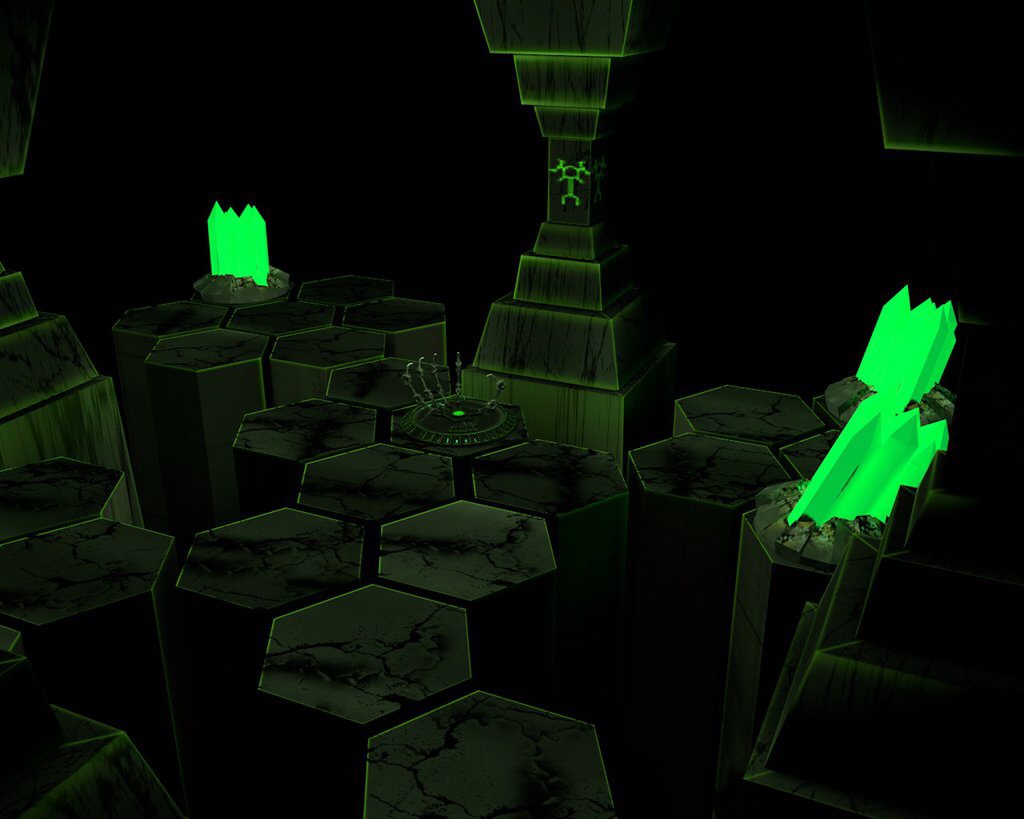
In the Tomb
Alerted by the sound of the stairs falling, Craven left tripwire grenades for von Klugge and his friend. Then he and Velati joined Craven at the entry to the lower level. They proceeded cautiously down the steps, with Craven searching for, but not finding, any traps. At the foot of the steps, a passage led off ahead of them beyond the range of their flashlights. The walls of the passage were covered with geometric patterns in the tannish stone. While continuing the search for traps down the passage, Niven discovered the outline of a concealed door.
As with the columns above, there appeared to be a combination blended into the tile work. Niven easily figured out mechanism and deciphered the combination with little effort. Beyond was a long room with ancient paintings on the walls with depictions of a Persian king doing heroic deeds. At the far end of the chamber, atop a small dias, sat a scepter atop a golden urn in which rest the ashes of the leader who is buried here.
Niven approached carefully, wary of either setting off any traps, or something emerging from the four sarcophagi on either side of the aisle. The scepter appeared to be made of gold and approximately two feet in length. There were inscriptions all over it, but he could not decipher them. When Craven joined him, the inscriptions seemed familiar in the same manner as the ones on the columns above did.
Niven examined the scepter and urn carefully. The scepter rested in a holder that sat directly on top of the urn. There was no sign of a mechanism. Craven read the inscription on the urn to learn that it did indeed contain the remains of Amir Khan. Niven considered various options before looping string around the ends of the scepter. He then stretched more string to the door of the chamber. When all were clear of the room, Niven adeptly pulled the scepter off the rack.
In an instant, a huge stone slap dropped in front of teh stairs back to the temple above. Searching for other avenues of escape, Velati discovered another concealed door on the opposite side of the passage. It appeared to have a similar mechanism to the concealed door to the scepter room. They elected to explore further down the passage.
Just beyond flashlight range from the concealed doors, they found a short flight of stairs. The steps were decorated with alternating tan and greenish tiles. Craven noticed that stone of the walls going from that point forward from stairs on were that same green, while the walls they had already passed through were the same tan. Niven was confident that there was a trap in the stairs, so he put pitons into the wall and climbed along to get past stairs. Craven followed, but slipped off pitons onto steps, which caused a stone block to block the passage behind them. The passage they were in was bathed in a greenish luminescence.
They followed the passage until it emerged into a large chamber. In stood an enormous and black control board covered with knobs, dials, gauges, handles, displays, and impressive sets of relays and junctions. Along the sides were more panels with lights and gauges. One portion of the control board was open with conduits and connections dangling from the open panel. Clearly as piece was missing. Craven tried to repair console, but the missing pieces were not apparent.
In the mean time, there were exits on each side of the room. Velati looked into one, but his light could not penetrate darkness. Niven into the other and found equipment a room of equipment. He looked around found some strange rifles, cartridges, and some unusually light broadswords, all of extraterrestrial design. They joined Velati. Niven could not see in to the chamber either, but Craven saw another room like the equipment room, but filled with various alien devices and the probable missing piece of panel.
Craven walked in, but Niven found holes in the side of portal at knee level. The trap did not trigger for Craven. Niven stepped over them and discovered a hexapodal invertebrate, resembling a gargantuan octopus, but with thicker and stronger limbs. It had a cluster of eyes. The central body was covered by a tough shell of cartilage. The thing picked up a device from a shelf . Niven felt a pressure in his mind and shot the thing. Hearing the shot, Velati entered the chamber. Craven tried to communicate with it. He felt the pressure in his mind.
Suddenly they felt dizziness and nausea, and then Velati and the thing faded away. There was a distant rumbling sound. Craven thought that repairing the console might avert whatever was happening. While he went for the component, Niven returned to the large chamber, where he was fired upon by von Klugge and his lieutenant, who had caught the grenade in the temple. Niven shot the lieutenant with the strange rifle. It burned a hole through his uniform, but the henchman was unharmed.
Craven charged von Klugge but did not hit is foe. Niven shot at von Klugge, and the German took cover. Craven tried to repair console, but could not get it to work. The rumbling grew more urgent. The lieutenant pushed Von Klugge from the room. Niven gave chase. He shot at them down the long passage, which was no longer blocked at the steps. The two concealed doors were open. The enemy went through the door to sarcophagus chamber before a stone slab seal it it off.
Craven was still fiddling with the console when Niven felt moving air coming from the remaining door. He grabbed Craven and let him down the passage and through the door. When they entered the chamber, metal doors at the other end slid silently into the side walls, revealing a short, open-topped passage ending a rocky outcropping. The air was hot, dry, and thin. There were no clouds. The sky was pink, and there was a large moon before them.
The Team
- Sir Lyton Niven, Gentleman Thief and Spy
- Capt. Philip Harrison Craven, WWI Flying Ace
- Arashk Velati, Persian guide